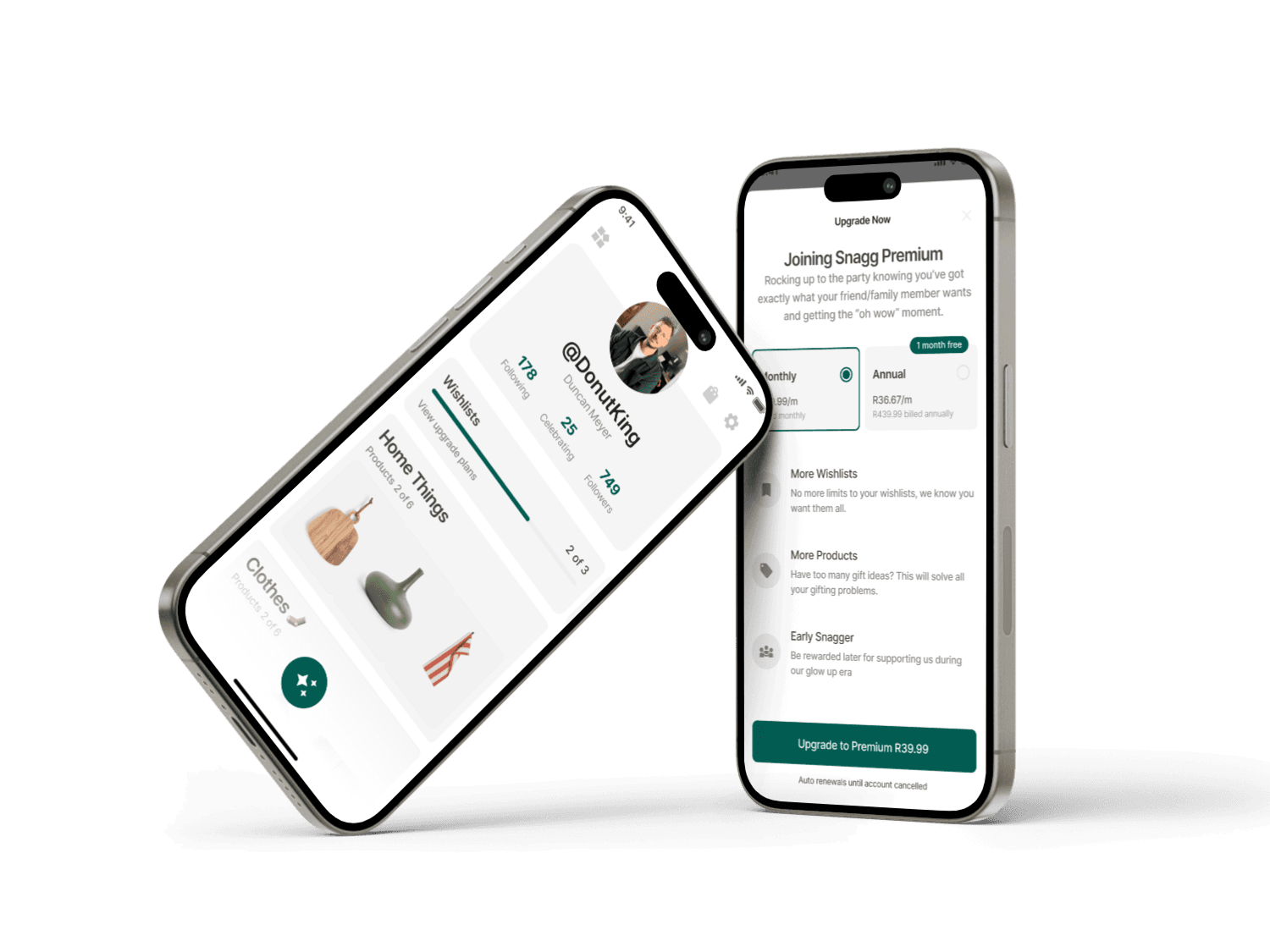
Snagg
Apps · 2026
App development covers everything between an idea with wireframes and a product live in both stores: authentication, data, payments, notifications, review submission, and the unglamorous edge cases that decide whether people keep the app installed.
Getting to the App Store is the easy half. Staying installed is the part that needs engineering.
FlutterFlow and Flutter for cross-platform delivery, so iOS and Android ship together instead of one trailing the other by a quarter.
Firebase or Supabase for auth, real-time data, and storage, with security rules and access control written deliberately rather than left open and forgotten.
RevenueCat for in-app subscriptions, Stripe or Yoco for web billing, with webhook lifecycle handling so access actually revokes when someone cancels.
App Store and Play Console setup, review submission, deep links with store fallbacks, push notifications, and a support window for the bugs that only appear once real users arrive.
Last time we did this
Champs FC is a venture we run with a business partner, built end to end: Google sign-in, public and private pools, rounds that settle themselves on a schedule, lifecycle email, and over 600 automated tests behind it.
How a round runs
App development
Every project is scoped and priced individually. Your quote is fixed in writing before anything starts.
A focused MVP with authentication, a core feature set, and a backend sits at one end; apps with subscriptions, real-time social features, complex permissions, or handling sensitive documents sit at the other. Describe the product and you will get a written scope and a fixed price within two business days.
Six to twelve weeks for most first releases, plus one to two weeks of store review and fixes. Scope discipline matters more than team size here.
Because one codebase ships to both stores at roughly half the cost and half the calendar time, and it drops to custom Flutter code wherever the visual builder runs out. Native is the right call when you need heavy on-device processing, deep OS integration, or platform-specific hardware. For most products, it is a budget spent on parity rather than progress.
Yes. Figma files get built to spec. WillPortal was translated pixel for pixel. If there are no designs yet, design is scoped as part of the project rather than assumed.
